An immersive digital art installation – co-created with young people from the Fens, using 3D modelling, motion capture and AI to bring the 3,000 year old Must Farm settlement to life.

Fen to Fire brings the Late Bronze Age Must Farm settlement to life using digital archaeology techniques including 3D modelling, motion capture, and AI. Created by digital artist Guy Schofield and young people from Cromwell Community College, Chatteris, the project reconstructs a photorealistic world from archaeological evidence, inviting audiences to experience the settlement’s entire lifespan — from its construction and daily rhythms to its dramatic destruction by fire. Using AI, every life cycle of the site is different, with activities, people, weather and viewpoints changing, meaning no two visits are ever the same.
Produced as part of Collusion’s SHAPE Hub programme with the University of Cambridge, this R&D project began with a desire from the Cambridge Archeological Unit (CAU) to connect their Must Farm research with local Fenland communities, particularly young people. Collusion worked with CAU to develop a national artists’ callout focused on delivering these outcomes. Three artists were then selected and paid to take part in a two-day creative lab in Cambridge where they learned more about the research, went on a dig and connected with local cultural partners who could support delivery of their project ideas. Subsequently, the artists were supported to develop their project ideas further before one was selected: Fen to Fire by Guy Schofield. The intention was always that the project would engage closely with the research and the CAU team.
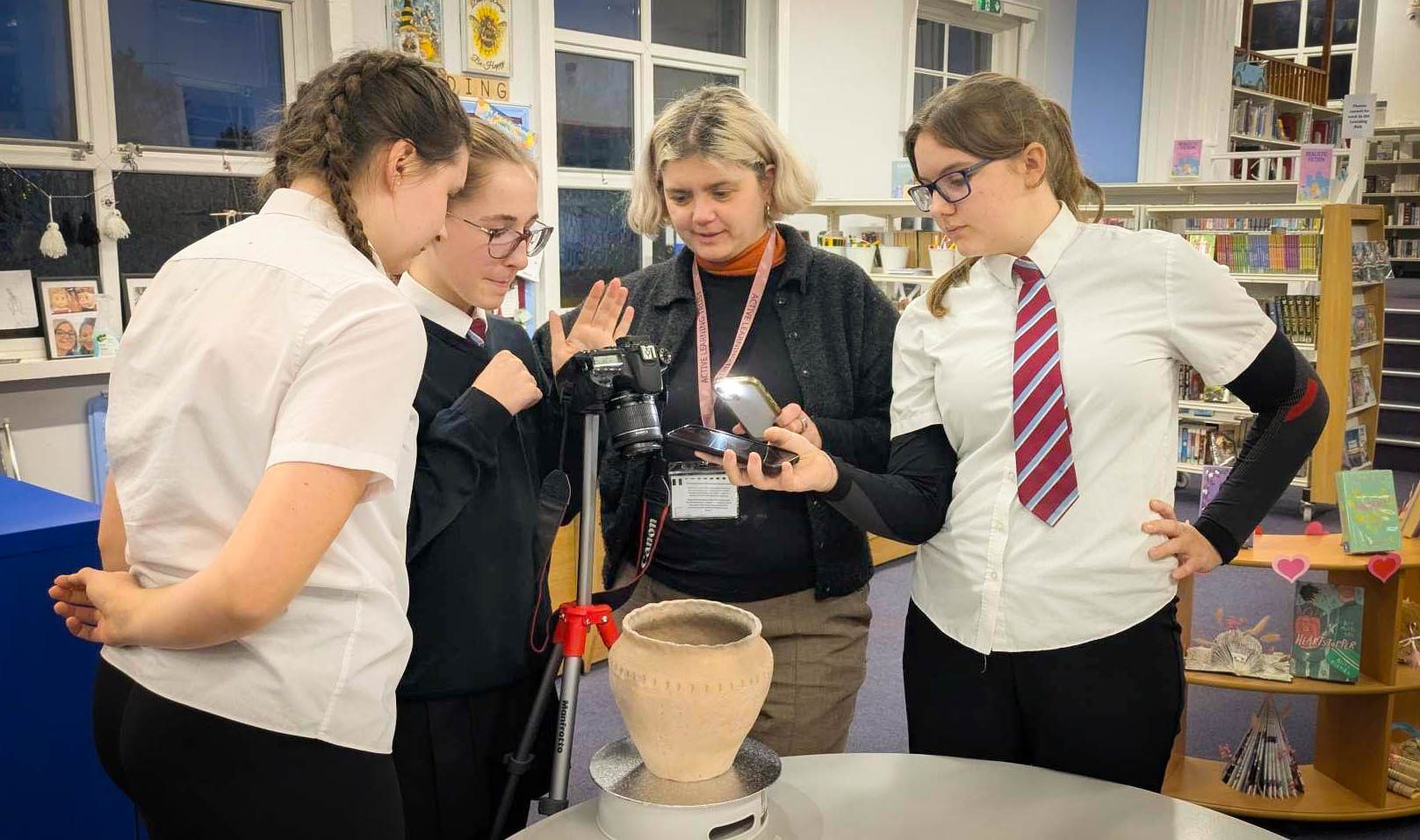
A series of workshops, led by Guy and Collusion, engaged participants in exploring archaeology and using creative technologies to bring the Must Farm community to life. Activities included handling replica Bronze Age artefacts, using photogrammetry to build 3D models, designing characters inspired by people the students knew — particularly their teachers, and capturing their own movements using DeepMotion to populate the settlement. The result is a relatable reconstruction shaped by the perspectives of young people living in Fenland today.
The young participants, many of whom were somewhat sceptical of the relevance or role of archaeology in their lives, demonstrated positive changes to their experiences and knowledge of the subject, in addition to developing new digital skills through the workshops. At the launch, the archeologists were fascinated to hear the young people telling their parents all about archeology of Must Farm and how they’d used it alongside their own experiences to inform the project.
— Participant, Cromwell Community College
The resulting free installation is version 1.0 of Fen to Fire. A large central screen displays the living reconstruction alongside two supplementary screens showing behind-the-scenes workshop footage and archaeological context.
Fen to Fire was shown at Everyspace, March Library from April to May 2026 and at the Creative Cambridge conference on 14 May, engaging over 250 delegates with its story.
— Dr Chris Wakefield, Engagement Officer, Cambridge Archaeological Unit
Nearly half the visitors had never been to March Library before, with many making a special journey to see the exhibition. Visitor feedback reflected an appreciation of the project’s co-creation with young people, and a fascination with seeing a reconstruction of how people might have lived 3000 years ago in the Fens.
— Visitor, March Library
Following a period of private presentation in the University of Cambridge’s McDonald Institute for Archeological Research, the work will be available to tour locally. Collusion, Guy and CAU are now exploring further development of the work, including as an immersive experience.
Artists
Creative team
Guy Schofield (Lead artist) works with museums, heritage organisations and communities across the UK, using videogame technologies to explore local heritage and archaeology. He is also a senior lecturer in Digital Archaeology at the University of York.
Chris Wakefield (Producer) has been both an archaeologist and engagement coordinator on the Must Farm project and currently works as the Engagement Officer for the Cambridge Archaeological Unit.
Rosa Torr (Engagement) is an interdisciplinary producer specialising in community and cultural engagement projects, working especially with communities who don’t often receive access to arts. Rosa supported the facilitation of the community engagement sessions.